
Your website is your virtual storefront, it serves as the initial point of contact with potential customers located in Blackpool.
Navigating the intricacies of the digital landscape requires a strategic and well-informed approach to Search Engine Optimisation (SEO).
Here, we run you through the inner workings of SEO Blackpool, showing you the top 10 techniques that will not only enhance your website’s visibility but propel it into the forefront of the local Blackpool community, helping to drive your brand name forward, increase enquiries and boost sales.
Content Included:
- Content is King, But Quality Rules
- Optimise for Mobile-First Indexing
- Snippets and Featured Content
- Voice Search Optimisation
- Local SEO Matters
- Video Content Dominance
- Page Load Speed
- User Experience (UX) Optimisation
- Social Media Integration
- Regular SEO Audits

1. Content is King, But Quality Rules:
Quality content isn’t just a buzzword; it’s a necessity. Google’s algorithms prioritise informative, well-researched content.
According to Semrush general blog posts should be between 1.500 and 2.500 words in length.
The pivotal role of quality content is underscored by statistics revealing that pages with longer, well-crafted content significantly outperform their counterparts.
Backlinko’s extensive study examining 11.8 million Google search results found that the average word count of a first-page result was around 1,900 words.
This approach to content creation is a testament to the changing dynamics of search engine algorithms, where depth and relevance supersede brevity.
Moreover, quality content not only attracts readers but also enhances user engagement. A study by Nielsen Norman Group discovered that users read only about 20% of the text on an average web page. Hence, it is imperative to craft content that not only captures attention but also sustains it.
2. Optimise for Mobile-First Indexing:

Mobile optimisation is no longer a choice but a requirement. Over 60% of Google searches are conducted on mobile devices. Additionally, Google now primarily uses the mobile version of a site’s content for indexing and ranking. A seamless mobile experience not only satisfies users but also boosts your search engine rankings.
As of 2024, mobile-first indexing is not just a recommendation but a foundational necessity for effective SEO. Google’s mobile-first indexing prioritises mobile versions of websites, considering them the primary source for ranking and indexing.
With over 50% of global web traffic originating from mobile devices, this shift aligns with user behaviour.
Google’s official statement highlights that the majority of websites are now crawled and indexed based on mobile content, emphasising the paramount importance of mobile optimisation.
Furthermore, research by Statista reveals that, as of 2023, there are over 3.8 billion smartphone users worldwide, underscoring the undeniable reach of mobile devices.
Websites that offer seamless mobile experiences tend to rank higher in search results, as confirmed by Google’s Mobile-Friendly Test. Ensuring your site is mobile-responsive is not just about catering to user preferences but is a strategic imperative for optimal search engine performance.
3. Snippets and Featured Content:
In 2024, securing a coveted spot in featured snippets will be a game-changer for Blackpool SEO success. A study by Ahrefs found that around 12.29% of search queries have featured snippets, occupying the ‘position zero’ above organic search results. This prime real estate significantly boosts visibility and click-through rates.
Moreover, data from HubSpot indicates that content with featured snippets witnesses a 2x higher Click-Through Rate (CTR). This underscores the pivotal role snippets play in capturing user attention and fostering increased engagement.
Google’s algorithms increasingly prioritise content that succinctly answers user queries, making it essential to structure content for snippet optimisation.
By providing concise, valuable information in a format easily digestible by search engines, your content stands a higher chance of being featured, elevating your website’s prominence in search results.
4. Voice Search Optimisation:
The surge in voice-activated virtual assistants has reshaped how users interact with search engines. Synup estimates that by 2024, half of all online searches will be conducted via voice. This seismic shift in user behaviour demands a proactive approach to Voice Search Optimisation (VSO).
Google’s algorithm, enriched by Natural Language Processing (NLP), strives to comprehend conversational queries. Harnessing the power of VSO becomes paramount, given that 41% of adults conduct at least one voice search daily, according to NMQ Digital. Websites optimised for voice queries stand poised to tap into this burgeoning user trend.
Incorporating long-tail keywords, natural language, and FAQ-style content enhances your site’s voice search compatibility. Adapting your SEO strategy to accommodate the nuances of voice search ensures your website is not just visible but resonates with the growing legion of voice-activated search users.
5. Local SEO Matters:

For local businesses, local SEO is a game-changer. Google’s “near me” searches have seen a 150% increase in the last two years. Optimise your Google My Business profile, encourage customer reviews, and ensure your location details are accurate for local success.
Local SEO emerges as a linchpin for businesses aiming to thrive in their immediate vicinity. Google reports that nearly 46% of all searches have local intent, emphasising the significance of local SEO strategies.
A Media Genesis study reinforces this, revealing that 78% of local mobile searches result in offline purchases, underscoring the conversion potential tied to localised visibility.
Furthermore, a robust local SEO strategy can significantly impact mobile users, as 88% of consumers who perform local searches on their mobile devices visit or call a store within a day.
Google My Business (GMB) optimisation, local keyword targeting, and garnering positive local reviews are pivotal for businesses seeking to fortify their local presence.
By aligning your website with local SEO best practices, you’re not just enhancing visibility but also tapping into a vast pool of potential customers with explicit intent—a strategic imperative for businesses navigating the intricacies of the contemporary online ecosystem.
6. Video Content Dominance:
The ascent of video content to SEO supremacy cannot be overstated. Cisco predicts that in 2024, video content will account for 82% of all internet traffic. This seismic shift underscores the need for businesses to integrate compelling video elements into their online presence.
Notably, pages with video content are 53 times more likely to rank on the first page of Google search results, according to Forrester Research. This statistic underscores the undeniable correlation between video content and enhanced search engine visibility.
Moreover, the dwell time—how long a user stays on a page—is a critical SEO metric. Wistia’s research reveals that users spend 2.6 times more time on pages with video compared to those without. This extended engagement signals to search engines that the content is valuable, positively influencing rankings.
Incorporating diverse and engaging video content not only enriches user experience but also propels your website into a more prominent position in search engine rankings, aligning with the evolving dynamics of user preferences and search algorithms.
7. Page Load Speed:
The speed at which your website loads is an unequivocal determinant of its success. Google has been unwavering in emphasising the significance of page speed as a ranking factor, and the user-centric approach of this directive is evident in statistics. A study by Google indicates that as page load time increases from one second to ten seconds, the probability of a mobile site visitor bouncing increases by 123%.
Moreover, user expectations are evolving rapidly. A 2024 survey by Akamai found that 47% of consumers expect a webpage to load in two seconds or less. This underscores the pivotal role of swift page load speed in retaining user engagement and satisfaction.
To align with contemporary SEO standards, prioritising optimisations such as image compression, streamlined coding, and leveraging browser caching becomes imperative. By enhancing your website’s speed, you not only cater to user expectations but also earn favour in the algorithms that determine search engine rankings.
8. User Experience (UX) Optimisation:
User satisfaction directly impacts rankings. A well-optimised UX reduces bounce rates. According to Google, if a page takes more than three seconds to load, over half of users will leave. Focus on intuitive navigation, clear calls-to-action, and visually appealing designs for a positive user experience.
User Experience (UX) Optimisation has emerged as a linchpin for digital success. According to a study by Adobe, websites that prioritise a seamless user experience witness a 1.6 times higher brand satisfaction.
Moreover, the bounce rate—a metric critical to SEO—correlates strongly with user experience. Google Analytics data indicates that websites with longer load times have higher bounce rates, accentuating the direct link between website performance and user engagement.
Furthermore, UX extends beyond speed; it encompasses mobile responsiveness, intuitive navigation, and engaging design.
A Statista report reveals that 53.3% of global web traffic comes from mobile devices, emphasising the need for websites to be optimised for diverse screen sizes.
By aligning your website with optimal user experience principles, you not only satisfy visitors but also position yourself favourably in search engine algorithms that prioritise user satisfaction.
9. Social Media Integration:

The role of Social Media Integration stands as a major force in shaping digital success.
According to a study by Hootsuite, 3.6 billion people worldwide are active on social media, underscoring its unparalleled reach.
This integration is not merely about having a social presence but leveraging it strategically to amplify your website’s visibility.
Search engines increasingly consider social signals as indicators of a site’s authority and relevance. Google’s algorithms, in particular, factor in social signals when determining search rankings. A Search Engine Journal report reveals that businesses with an active and engaged social media presence often experience higher search rankings.
Additionally, social media serves as a conduit for diverse traffic sources. By integrating your website with social platforms, you tap into an expansive network, fostering brand awareness and increasing the likelihood of content virality. Hence, the symbiotic relationship between social media and SEO is an indispensable facet of a holistic digital strategy.
10. Regular SEO Audits:
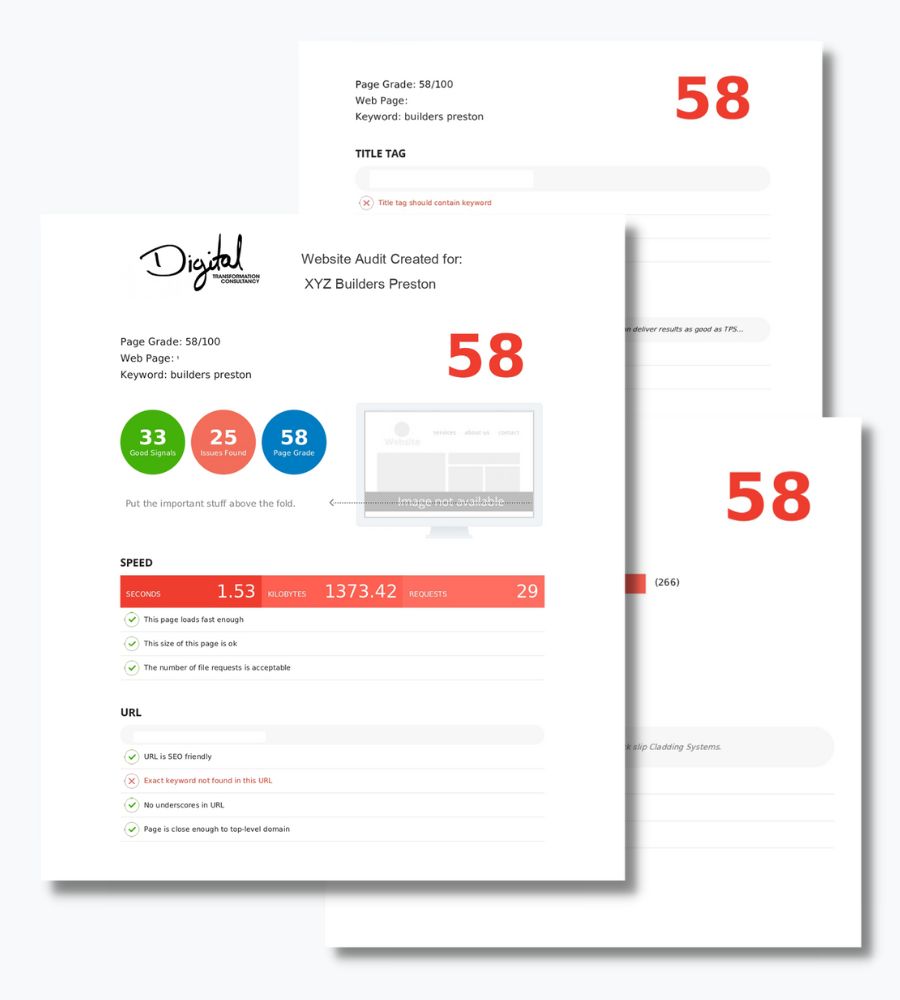
Google’s algorithms are in constant evolution, making periodic assessments crucial for maintaining and enhancing search visibility. According to a study by Backlinko, websites that conduct regular audits tend to rank higher in search results, highlighting the tangible impact of this practice.
A comprehensive SEO audit involves scrutinising on-page elements, backlinks, site structure, and performance metrics. The benefits are manifold, ranging from identifying and rectifying technical issues that could impede search engine crawlers to ensuring content aligns with the latest algorithms.
Online free auditing platforms such as Google Console and Google Analytics 4 are good places to start as it will provide important information on many aspects of your website such as dead links, mobile issues, and your website’s most popular pages.
Subsequently, we offer a free audit service which will highlight all the areas where your website requires attention. What’s more, we would also be happy to go through the audit with you via a quick ( no obligation, no pressure ) chat.
Moreover, regular audits serve as a preventive measure against potential penalties. Google penalties can severely dent rankings and visibility. A proactive approach, informed by audit findings, can fortify your website against potential pitfalls, ensuring a robust and enduring online presence.
In Conclusion
Implementing these important SEO strategies isn’t just about getting noticed; it’s about staying relevant in an ever-evolving digital landscape.
By embracing these SEO techniques backed by facts and statistics, your website is not only getting noticed but will be better positioned for sustained success.